The Village Green as a Place to Gather
Explore the village green as a place to gather: learn how to read its shared uses, choose a respectful spot and take part without disrupting local life.
A village green is easiest to join when you first notice what people already do there. The village green as a place to gather may host play, meetings, seasonal observances or simply a pause on a walk, but its customs and access vary from one community to another. Take a moment to read the setting before deciding where to sit or how to take part.
What is happening on this green today?
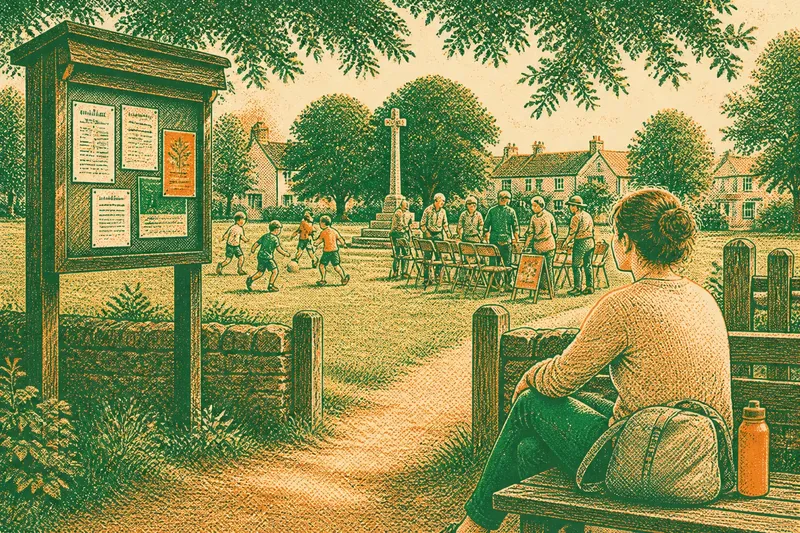
Begin at an entrance or path edge, rather than heading straight for the middle. Look for signs, an event noticeboard, temporary markers and the way people are using the space. A ball game, a quiet conversation and a gathering around a small display each call for different amounts of room.
Notice whether activity is organised or informal. A marked area, a steward or a group arranging chairs suggests a planned event. Children playing freely or neighbours talking in small clusters may indicate everyday use. Neither tells you everything, but both help you avoid interrupting.
Greens differ in character. One may be a broad open space beside a hall; another may have a memorial, a tree, a path through the centre or homes close along its edges. Follow any posted guidance, and don’t assume that a familiar custom in one village applies in another.
Where can you settle without taking over?
Choose a place that leaves the main route clear and gives others room to move. If people are gathering around a noticeboard, a bench or a central feature, keep that area accessible. A spot near the edge can make it easier to watch without joining a conversation or crossing through an activity.
Before spreading out a blanket or setting down a bag, check the ground and the nearby activity. Avoid blocking a gate, a path, a playing area or a place where organisers are working. If the green is busy, keep your belongings compact and be ready to move when someone needs the space.
Imagine you arrive while a group is setting up chairs for a village meeting and children are playing nearby. You could choose a quiet patch beyond the chair layout, keep your bag beside you and wait until the meeting begins before approaching the organisers. The result is a clear route for those setting up and a comfortable place from which to observe.
How do you take part in a local gathering?
Start with a small, courteous question. Ask an organiser whether visitors may join, where people should sit or whether an activity is open to everyone. At an informal gathering, a brief greeting and a moment to see how others respond can be enough. Let people set the pace rather than treating the green as an event staged for visitors.
For a meeting or observance, listen for any instructions about where to stand, when to speak and whether photographs are welcome. A community may use the same patch of grass for lively play at one time and a quiet remembrance at another. Match your conduct to the occasion, and put your phone away if attention is directed towards a speaker or shared moment.
If you bring children, explain the boundaries you have noticed and keep play away from people who are listening or arranging an event. If you bring a dog, follow local signs and keep it from disrupting games or close gatherings. The right choice depends on local rules and organiser guidance, so check the posted information where it applies.
Why does the green’s role change?
Shared spaces can hold several kinds of use without having one fixed purpose. People may meet there to play, discuss a local matter, mark a seasonal occasion or catch up after a walk. The layout, nearby buildings and community habits all shape what feels natural on a particular day.
That variety is part of the green’s character, not a promise that every activity is open to every visitor. A gathering may be private, a game may need the open centre, or a path may be busy with people passing through. Look for cues, ask when uncertain and accept a polite boundary without pressing for an explanation.
What should you check before you leave?
- Check for signs or event notices, then follow any directions they give.
- Look behind you for belongings, wrappers and anything you brought onto the grass.
- Make sure you have not left a bag, blanket or chair across a path or entrance.
- Leave memorials, planted areas and community displays as you found them.
- If an organiser has asked visitors to move or keep an area clear, do so promptly.
When you leave, avoid cutting through the centre of an activity simply because it is the shortest route. Use the path or edge you came by if it remains clear. A considerate departure matters as much as a considerate arrival: it lets the gathering continue without making your visit its main event.
What do visitors often want to know?
Can visitors sit on a village green?
Often, a green has places where visitors can pause, but access and permitted uses vary. Check signs and choose a spot that does not interfere with a game, meeting or organised event.
Can you join a village green event?
Ask an organiser or look for a notice explaining who may take part. If the gathering appears informal, greet someone and wait for a clear invitation before joining a private conversation or activity.
Is it all right to bring a picnic?
A quiet picnic may suit an open, uncrowded area, but avoid spreading out near an event or blocking a route. Take all rubbish with you and leave the space ready for its next use.
How can you tell when a gathering is private?
Invitations, signs, reserved seating or a closed circle of participants can signal that an event is not open to passers-by. If you cannot tell, ask politely or watch from a respectful distance.
For the village green as a place to gather, the useful habit is to arrive observantly, make room for the people already there and ask before joining. That approach lets you enjoy the shared space while respecting the local customs that give each green its own shape.