Cards or a Jigsaw for a Rainy Afternoon?
Cards or a jigsaw for a rainy afternoon? Match the pastime to your company, attention and available space for an easier, more companionable day indoors.
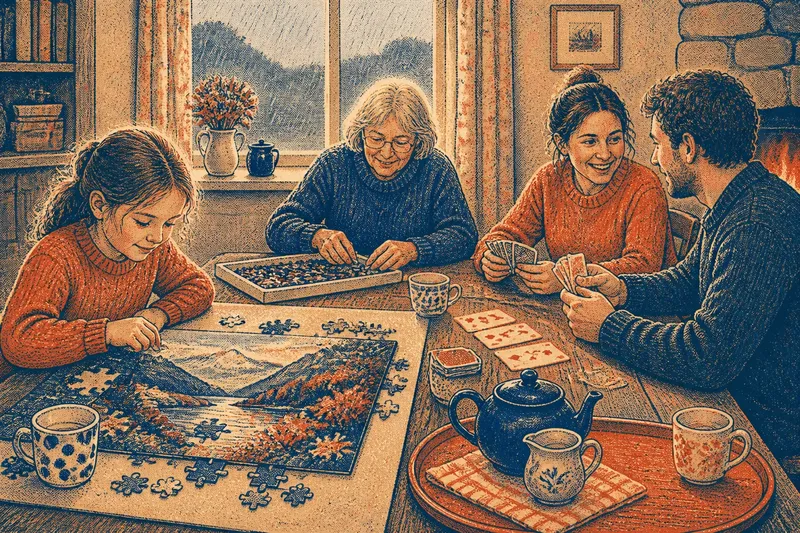
Cards or a jigsaw for a rainy afternoon? Choose cards if you want conversation to keep moving; choose a jigsaw if you want company that can settle into quiet. The difference is not simply competition versus patience. Each activity gives people a different way to join in, pause and share the room.
What kind of company suits cards or a jigsaw?
Cards suit a group that enjoys taking turns and responding to one another. A familiar game of rummy, snap or cribbage gives everyone a clear moment to act. Between turns, people can talk, pour tea or watch the rain at the window without losing their place.
A jigsaw suits people who like working side by side without needing to speak often. Someone can sort the edge pieces while another searches for colours or shapes. A person who drifts away can return and contribute without asking what happened in a round.
Think about how well the company knows the activity, too. A game with complicated rules can leave newcomers watching rather than playing. A jigsaw has no rules to explain, though a dense image may frustrate anyone who wants to see progress quickly.
Which pastime works when people arrive and leave at different times?
A jigsaw is usually easier to leave open between comings and goings. Put it on a stable table, and a late arrival can inspect the picture and add a piece. A card game is more exposed to interruption: one person leaving mid-hand can make the next turn unclear.
That does not rule cards out. Pick a game that can pause cleanly, or agree that people will join after the current hand. If the group is likely to scatter for a walk, a snack or a look at the weather, keep the game short enough that a break feels natural.
For a jigsaw, protect the work from cups, sleeves and pets. A puzzle mat or a large sheet of stiff card can make it easier to move the picture if the table is needed later. Keep the box image nearby so people can orient themselves without interrupting whoever is concentrating.
How much attention does each activity ask for?
Cards ask for brief, repeated bursts of attention. Players follow the rules, watch the current turn and remember what they need to do next. That rhythm suits a lively room, but it can be hard to follow if people are holding several conversations at once.
A jigsaw asks for attention that can come and go. Someone may spend a while matching a patch of sky, then step back to chat. There is no single correct pace, and the group can work on different parts without waiting for a turn.
Look at the mood rather than assuming one activity is always calmer. A tense card game can become noisy, while a difficult puzzle can make a quiet afternoon feel effortful. If people seem restless, try a simple, quick game; if they are already settled, a puzzle may fit better.
What should you choose for a mixed-age group?
Choose a card game whose rules can be explained in a few sentences and whose turns are easy to see. A simple matching game gives younger players a clear task, while adults can help without taking over. Avoid relying on a game that only one person knows well unless they are happy to teach it patiently.
A jigsaw can bring different ages together when the image offers several kinds of clues. Large, distinct objects give newcomers a place to start; broad areas of similar colour may suit someone who enjoys a longer search. Let each person choose a task rather than assigning everyone a section.
Say you have a family group in a cottage kitchen: one child wants to dip in and out, an older relative prefers a steady task, and two adults are catching up. Put a modest landscape jigsaw at one end of the table and a simple card game on a clear surface nearby. The child can add a few pieces, the relative can keep sorting, and the adults can play a round without asking the whole room to join the same activity.
How do you make room for cards or a jigsaw?
Cards need a dry, level surface with enough elbow room for hands, a discard pile and any shared cards. A small table can work if you choose a game that does not spread across it. Keep drinks on a separate tray or side table so a knock does not turn the game into a clean-up job.
A jigsaw needs space for both the working area and loose pieces. A shallow tray, biscuit tin lid or sorting dish can keep edge pieces and distinctive colours together. If the only table is also used for meals, a roll-up mat or stiff board lets you clear the surface between sessions.
In either case, keep the setup inviting rather than elaborate. Put out a deck or the puzzle box, make room for mugs and leave a comfortable chair accessible. A rainy afternoon often has interruptions; a pastime is more likely to last if restarting it takes little effort.
Which pastime is easier to pause and resume?
A jigsaw is simple to resume because the picture remains in view. A player can scan the open spaces and choose a new area without reconstructing the group’s progress. If the puzzle must be put away, keep loose pieces in a lidded container and note which pieces were still being sorted.
Cards are easy to pause between games, but less convenient in the middle of a hand. Put the deck aside only after everyone agrees where the round stands. If the group has different arrival times, treat each game as its own small session rather than trying to preserve a complicated position.
Some puzzles come with a useful storage board, while card games vary in how much room they need. Follow the maker’s instructions for any supplied mat or components, and check local rules if the activity involves a public venue or shared community space.
What should you choose if people want different levels of conversation?
Choose cards when the group wants conversation to have a common thread. The game supplies a reason to laugh, tease or tell a short story, even for people who do not know one another well. Keep the rules light if talking matters more than keeping score.
Choose a jigsaw when company is welcome but conversation should remain optional. It gives hands something to do during pauses and can make a shared room feel sociable without demanding eye contact or constant replies. That can be especially useful when guests are tired from travelling or the weather has changed outdoor plans.
You can also let the afternoon change shape. Begin with a few rounds of cards, then leave the deck aside if people start looking for a quieter activity. Or work on a puzzle until someone suggests a game. The point is to notice what the group is doing, not to defend the first choice.
How do you decide between cards and a jigsaw?
Use the room, the company and the likely interruptions as your guide. Cards offer a shared rhythm and clear turns; a jigsaw offers open-ended, side-by-side participation. Neither needs to occupy everyone for the whole afternoon.
- Choose cards if the group enjoys quick exchanges and taking turns.
- Choose a jigsaw if people want to join or leave without announcing it.
- Pick a familiar, simple game when some players are new to cards.
- Choose a puzzle image with varied colours and recognisable details for mixed experience.
- Use cards when table space is limited; use a board or mat if a puzzle must be moved.
- Keep both options available if the group’s energy is hard to predict.
For cards or a jigsaw on a rainy afternoon, the useful question is what kind of company feels comfortable just now. A deck makes a small social event of each turn; a puzzle lets people share a task at their own pace. Leave room for the answer to change as the afternoon unfolds.