The Big Launch Is Not the Whole Project
A community project launch is only a beginning. Make follow-through clear and welcoming, so neighbours know what they can do next and how to stay involved.
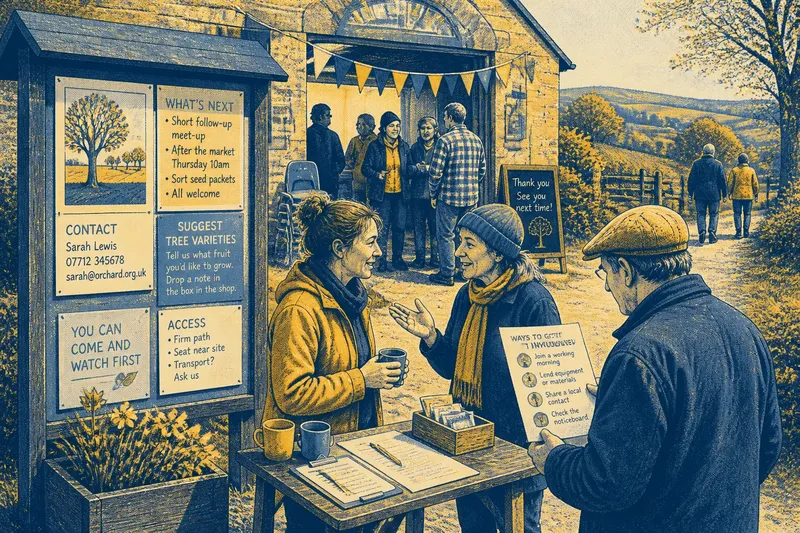
A village hall can be full for a community project launch, yet the chairs still need stacking when the last guest leaves. The launch matters, but what happens next gives neighbours a clear way to return without assuming they have signed up for regular work.
For a community garden, footpath group or local gathering, make the next invitation specific, keep practical details visible and share the routine jobs. That turns a one-off welcome into a useful opening for people who came and those who missed it.
What should a community project launch do?
Give the gathering a modest, practical purpose. Introduce the people coordinating the project, show where to find updates or let visitors try one small activity. Do not ask the day to prove that the whole community supports the idea.
Before people arrive, prepare a few details that show what happens after the bunting comes down:
- Check that a notice by the entrance gives the next date and a named contact; if both are confirmed, display them, but if either is undecided, say when the information will be added.
- Check whether visitors need to know where tools, sign-up sheets or project notes are kept; if they do, point out the location, but if those items are not ready, name who will provide an update.
- Check that one activity can be joined without a long commitment; if so, explain how to take part, but if it needs prior preparation, offer a simple way to watch or ask questions instead.
- Check which parts of the plan remain undecided; if there are open choices, name them, but if a decision is settled, explain that it is already part of the plan.
- Check how people can hear about changes without social media; if a noticeboard or newsletter is available, use it, but if not, name another agreed contact route.
These are invitations, not requests for immediate pledges. Someone may want to look around, speak to a neighbour and leave. Letting people do that can make a welcome feel more genuine than building the launch around collecting names.
How can you make the next visit easy to picture?
Offer a clear action with a time, place and task. “We need help” leaves a visitor guessing what is needed, when to come and whether they have the right skills. “Come by after the market on Thursday to sort seed packets” gives them something concrete to consider.
Provide different ways to contribute. One neighbour might join a scheduled working morning; another might lend a folding table, share a local contact or check a noticeboard. Be honest about what each option requires. Do not describe occasional help as enough for a role that needs dependable cover.
Say the organisers are starting a small community orchard, and imagine the launch draws a dozen curious visitors. They invite everyone to a short follow-up meet-up, post its date at the shop and offer a separate way to suggest tree varieties. The expected result is a clear next opportunity and a record of preferences, not an assumed roster of volunteers.
What needs doing when the event ends?
Agree who will handle the immediate handover before the gathering closes. Name someone to return borrowed chairs, remove signs, secure materials and pass on unanswered questions. If no one owns these tasks, they can linger until a neighbour quietly takes them on.
Keep a brief note of useful details: questions visitors asked, access information that caused confusion, repairs needed and follow-ups someone agreed to make. Share only what the group needs, and do not publish anyone’s contact details without permission.
Choose a rhythm the organisers can maintain. A short monthly drop-in, a seasonal working morning or a notice pinned up before each gathering may suit the group better than a crowded calendar. Leave room for weather, harvests, school terms and other commitments that shape rural weeks.
How can neighbours join if they missed the launch?
Do not make opening day the only doorway. With permission, put essential information somewhere people already pass: a village noticeboard, parish newsletter, community hall entrance or local shop window. Say what the project is, where it meets, who can answer questions and what a newcomer can do without prior experience.
Use plain wording. “You can come and watch first” may feel more reassuring than a broad appeal for helpers. Mention relevant access details, such as whether there is a firm surface, a nearby seat or a way to ask about transport. Describe what is actually available rather than promising arrangements that are not in place.
Make room for people who do not want to join a group. A neighbour might use a new path, attend a seasonal gathering or simply want to know when work is taking place. Being informed and respected can be a form of participation too.
Which questions help keep the project on track?
How can organisers tell whether the launch was useful?
Ask what visitors could understand or do because they came: find the site, meet a contact, try an activity or learn the next date. A lively room is pleasant, but it does not tell you whether the project is clear and usable afterwards.
What if only a few people return?
Check whether the invitation was clear, the timing workable and the task suitable for a first visit. A small group can still contribute, but organisers should not quietly take on more work than they can sustain.
Should the group hold another launch event?
Hold a celebration when there is something meaningful to share, such as a new season of activity or a completed stage. For routine updates, a notice, open session or short gathering may serve neighbours better than another large event.
How should organisers respond to suggestions they cannot adopt?
Thank the person, explain the practical constraint and say whether the idea could be revisited. If a decision is still open, give a realistic point when the group will respond instead of leaving the suggestion unanswered.
How can shared work stay fair?
Notice who handles the less visible jobs. The person who unlocks the hall, washes mugs, checks the path after rain or answers messages may do as much to sustain the project as the person who speaks at the launch. Name these tasks and share them where possible.
Set clear limits for each role. Instead of asking one neighbour to “look after communications”, agree on a specific job, such as updating the noticeboard before each gathering and passing questions to a named coordinator. A bounded task lets someone decide whether they can take it on without inheriting open-ended work.
If the project involves a public site, shared facilities or organised activities, check the relevant permissions and local arrangements before making commitments. The right process depends on the landowner, venue and activity, so confirm it with the responsible person rather than relying on an assumption made at the launch.
What can you do this week?
Choose one follow-up task and give it an owner. You might write the next date on the noticeboard, send a short update to people who asked for one or arrange for someone to put away borrowed equipment. If the date is not confirmed, post when it will be decided instead of displaying a guess.
Then ask a neighbour who missed the launch what information they would need to take part. Treat the answer as useful guidance, not a promise to volunteer. For a community project, a clear invitation and a named next opportunity make it easier for people to choose their own level of involvement.